
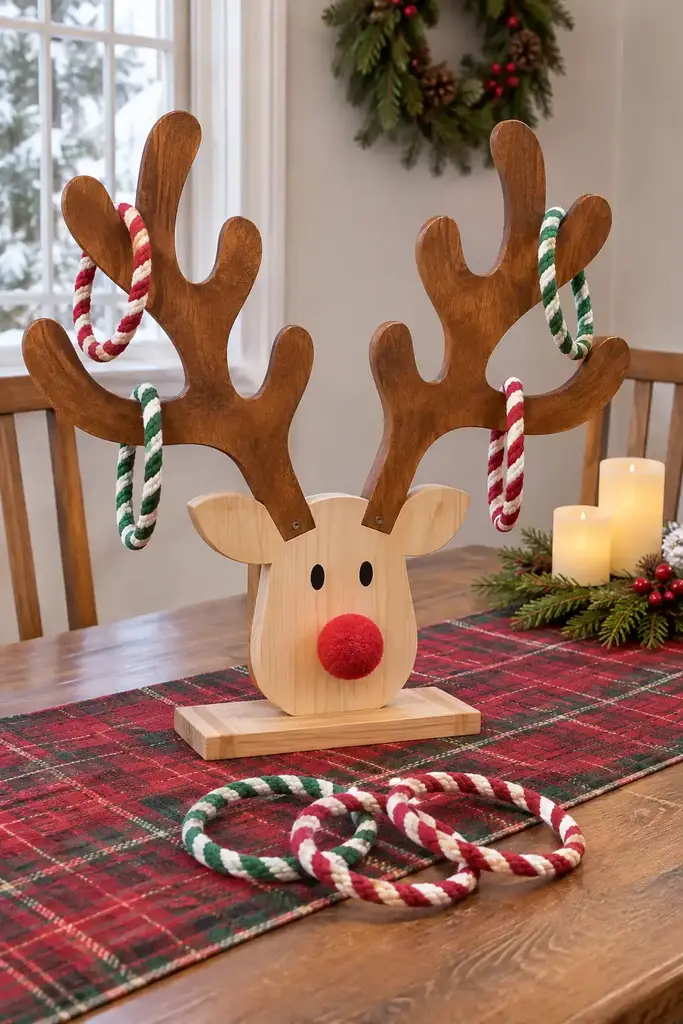
Christmas party game ideas work best when guests understand the rules before their first turn. Choose two active games and one seated activity. Keep scoring visible, and let anyone watch or skip a round.
These AI-generated images provide setup inspiration. The rules below are suggested versions, so adjust distances and round lengths for your guests. Plan the room around your activities using these Christmas events ideas.
In this post: 16 ideas
- Wooden reindeer ring toss
- Red cup Christmas tree challenge
- Picture card Christmas charades
- Ornament and spoon relay
- Soft snowball bucket toss
- Holiday picture memory match
- Tabletop candy cane hook game
- Picture bingo with reusable boards
- Wrapped gift stacking contest
- Place the nose on Rudolph
- Envelope scavenger hunt
- Jingle bell box shake
- Christmas trivia at the table
- Roll and build a snowman
- Christmas tree beanbag target
- Guess the Christmas scent
1. Wooden reindeer ring toss
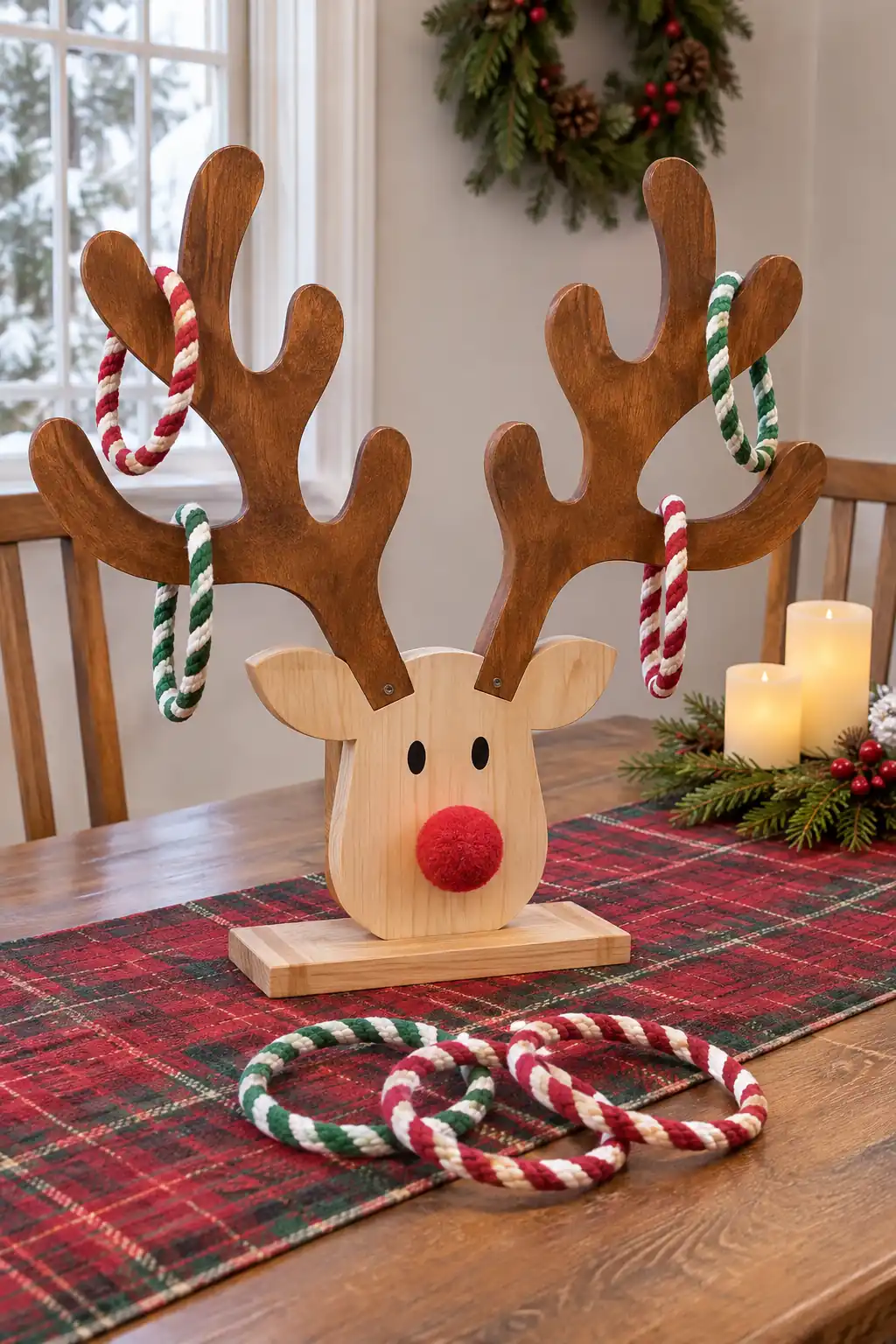
The reindeer target turns its antlers into several landing points for striped rope rings. A broad wooden base keeps the arrangement compact. Choose smooth antlers without sharp corners, then check that the target remains steady when a ring lands. Place it on a low table with empty space behind it.
Give each player three rings and count one point for every ring that stays around an antler. Mark a throwing line with removable floor tape. Move the line closer for younger players instead of changing the scoring midway. A seated player can throw from a chair at the same marked position.
Use soft rings that fit easily over the widest antler section. Hard, heavy rings can knock the target over. Keep drinks away from the landing area, and collect rings only after the final throw. For teams, add everyone’s points after an equal number of turns.
2. Red cup Christmas tree challenge
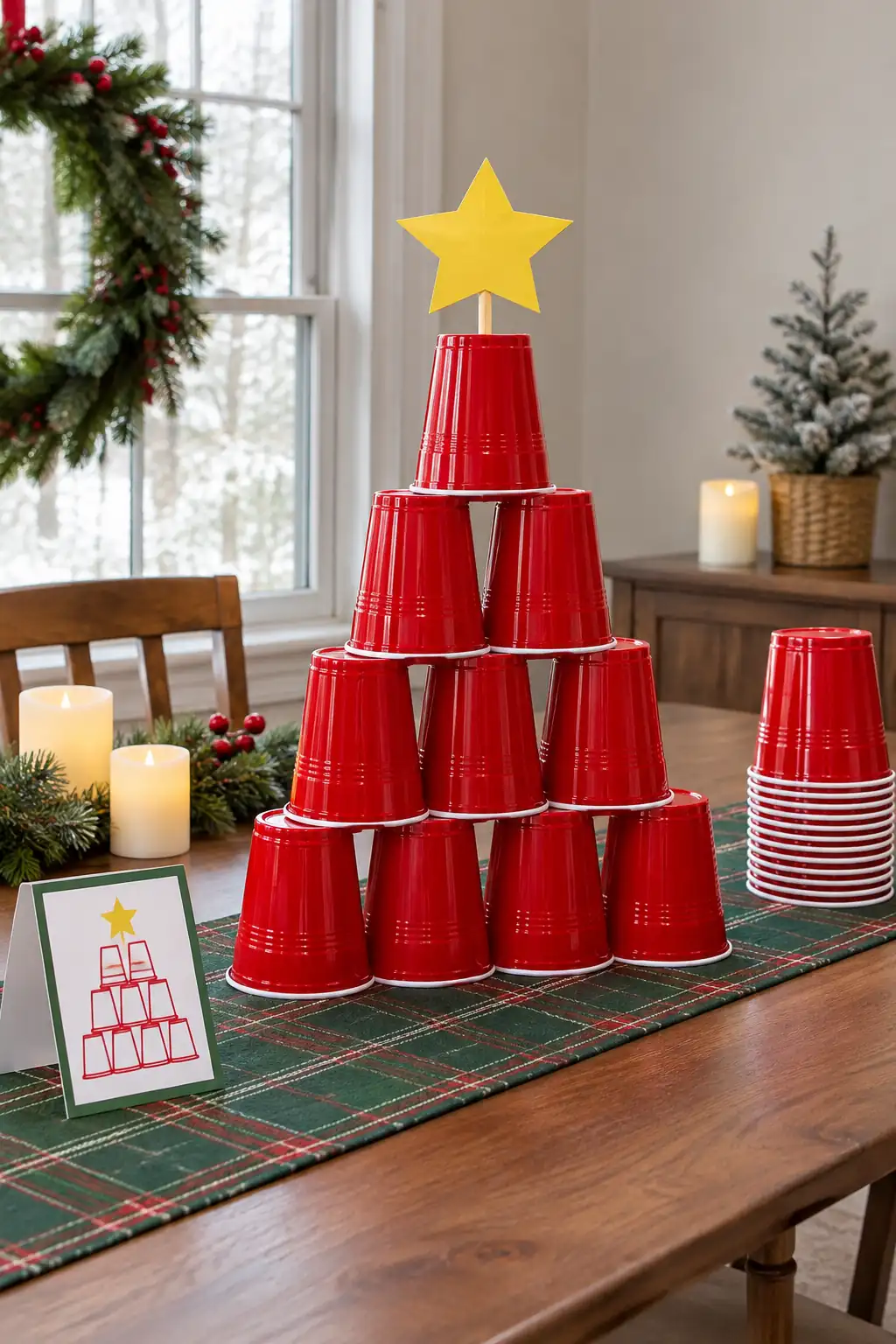
A pyramid of red cups creates a tree shape without requiring any cutting. The reference uses four cups across its bottom row. That arrangement needs ten matching cups in total. A paper star is a finishing decoration, so leave it off during fast stacking rounds.
Set ten cups in one nested stack for each player. Start a timer and ask players to build the pyramid, then return the cups to one stack. Decide beforehand whether a fallen cup requires a complete restart. For a relaxed family version, let players repair their tower while the timer continues.
Use a firm table rather than a thick, uneven cloth. Cups with different rim widths make stacking less predictable, so give everyone the same type. Younger children can build a six-cup tree without racing. Photograph the completed towers before clearing them, and store each set together for the next round.
3. Picture card Christmas charades
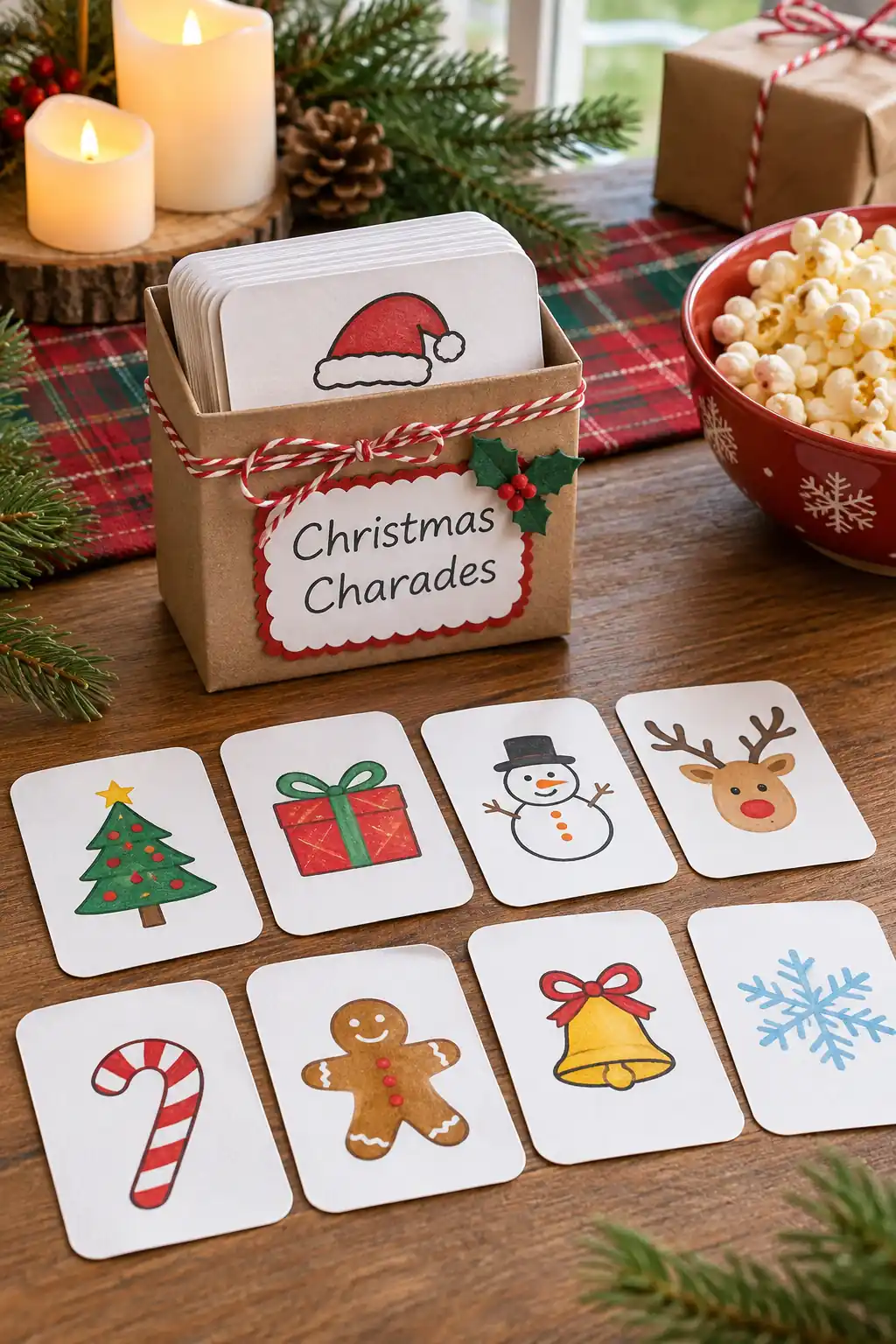
Picture cards let guests choose an action without reading a long prompt. The illustrated deck includes trees, gifts, bells, and a reindeer. Some pictures describe objects rather than actions, so agree on the intended mime before play. A gift might mean wrapping a present, while a bell could mean ringing one.
Divide guests into small teams and give each performer one card. Allow thirty seconds for guesses, with no spoken clues. Offer a replacement card if the picture feels unclear. Children can mime alongside an adult, and anyone uncomfortable performing can become the timekeeper or card chooser.
Keep duplicate prompts out of a single round so later teams do not gain an advantage. Put used cards in a separate pile. For quieter gatherings, play cooperatively and count how many cards the whole group solves. Store the deck with a short list of agreed actions for another Christmas gathering.
4. Ornament and spoon relay
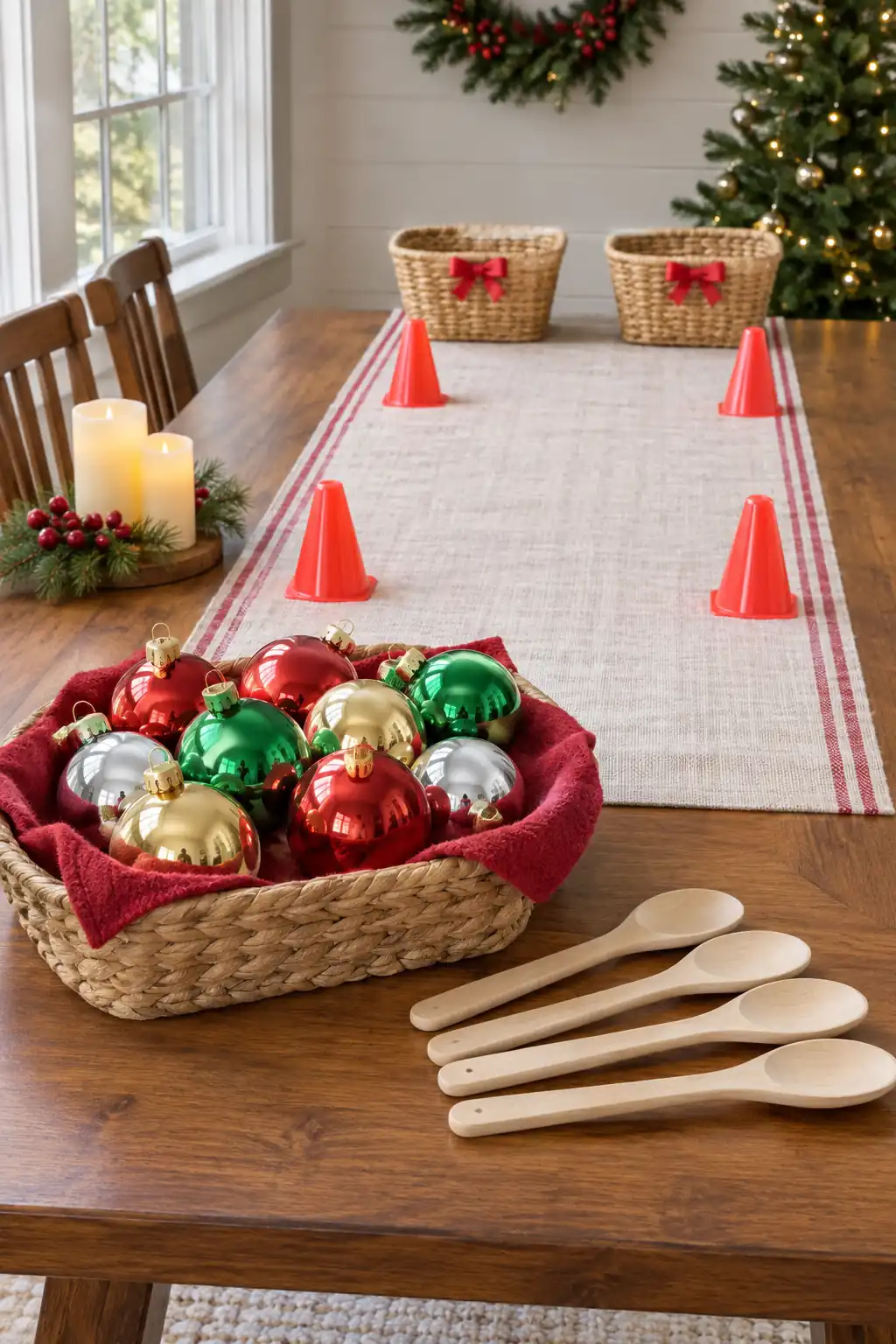
Large ornaments and wooden spoons create a balance game with an obvious Christmas theme. Choose lightweight, shatterproof ornaments with no loose hooks. The basket in the image keeps unused pieces together, while cones suggest a route. In practice, move the course onto a clear floor area rather than along a dining table.
Each player carries one ornament on a spoon held in their hand. Walk to a marker, turn, and return before passing the spoon. If the ornament falls, stop and replace it at that spot. Avoid holding spoons in mouths or encouraging running around furniture.
For mixed abilities, replace the relay with a seated transfer between two bowls. Use the same number of transfers for every participant. Test whether the ornament fits the spoon before guests arrive, because a narrow spoon can make the game frustrating. Place a collection basket at each end to prevent loose pieces rolling away.
You may also like: Christmas events ideas.
5. Soft snowball bucket toss
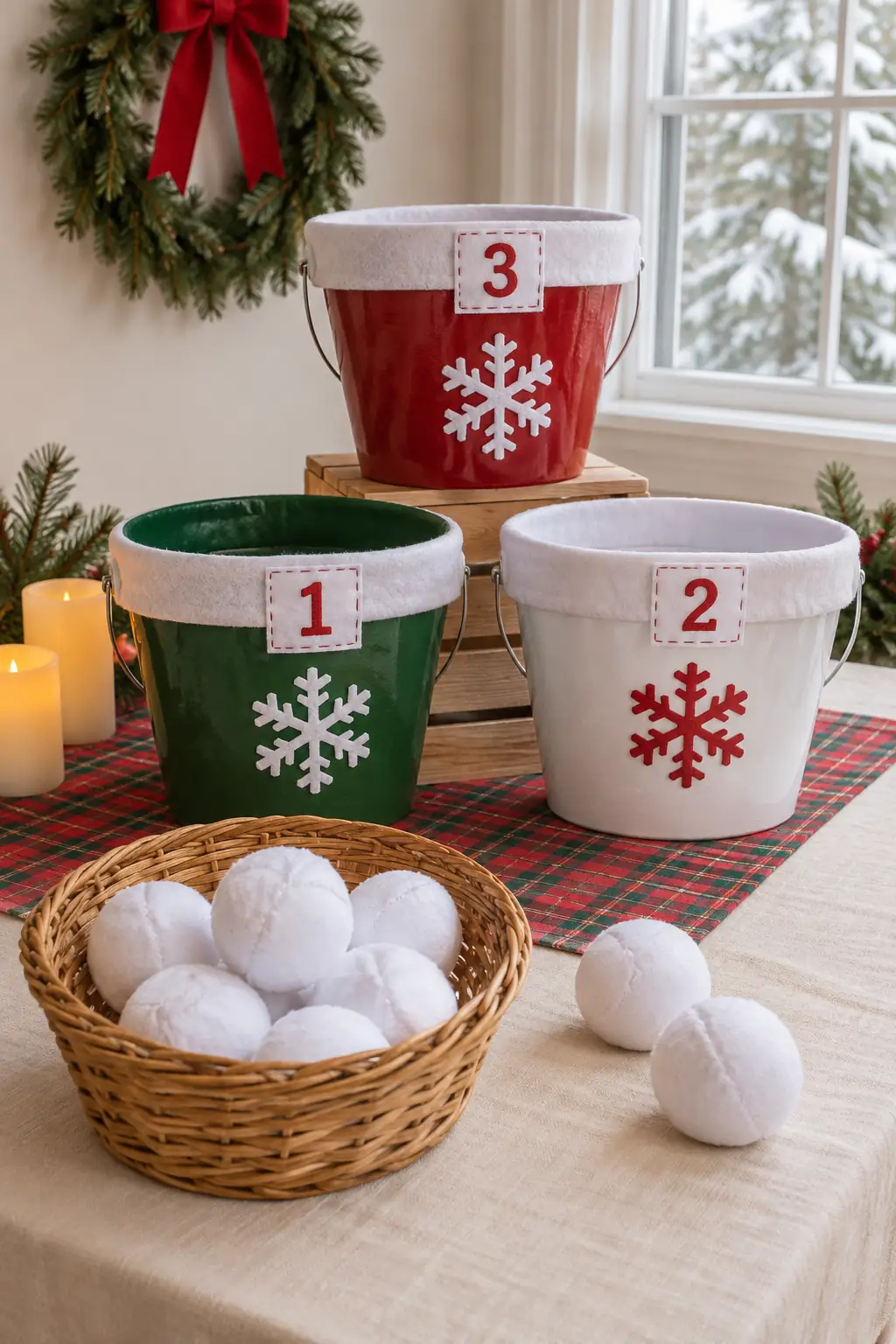
White fabric balls suggest snow without leaving melting water or loose cotton around the room. The three buckets create clear targets. Their numbered fronts can indicate points, but make sure the numbers match your actual scoring. Use stable containers with smooth rims and enough width to catch the balls.
Give each person five throws. Put the closest bucket worth one point, the next worth two, and the farthest worth three. Set the distances after a trial throw rather than choosing an awkwardly long course. Players may throw underhand while seated or standing.
Leave a clear area around the buckets, especially if missed balls could disappear beneath furniture. Ask players to wait before collecting their throws. For a cooperative version, choose a shared target score and let everyone contribute. Washable fabric balls are easier to keep for future parties than loosely wound cotton balls that shed during play.
6. Holiday picture memory match
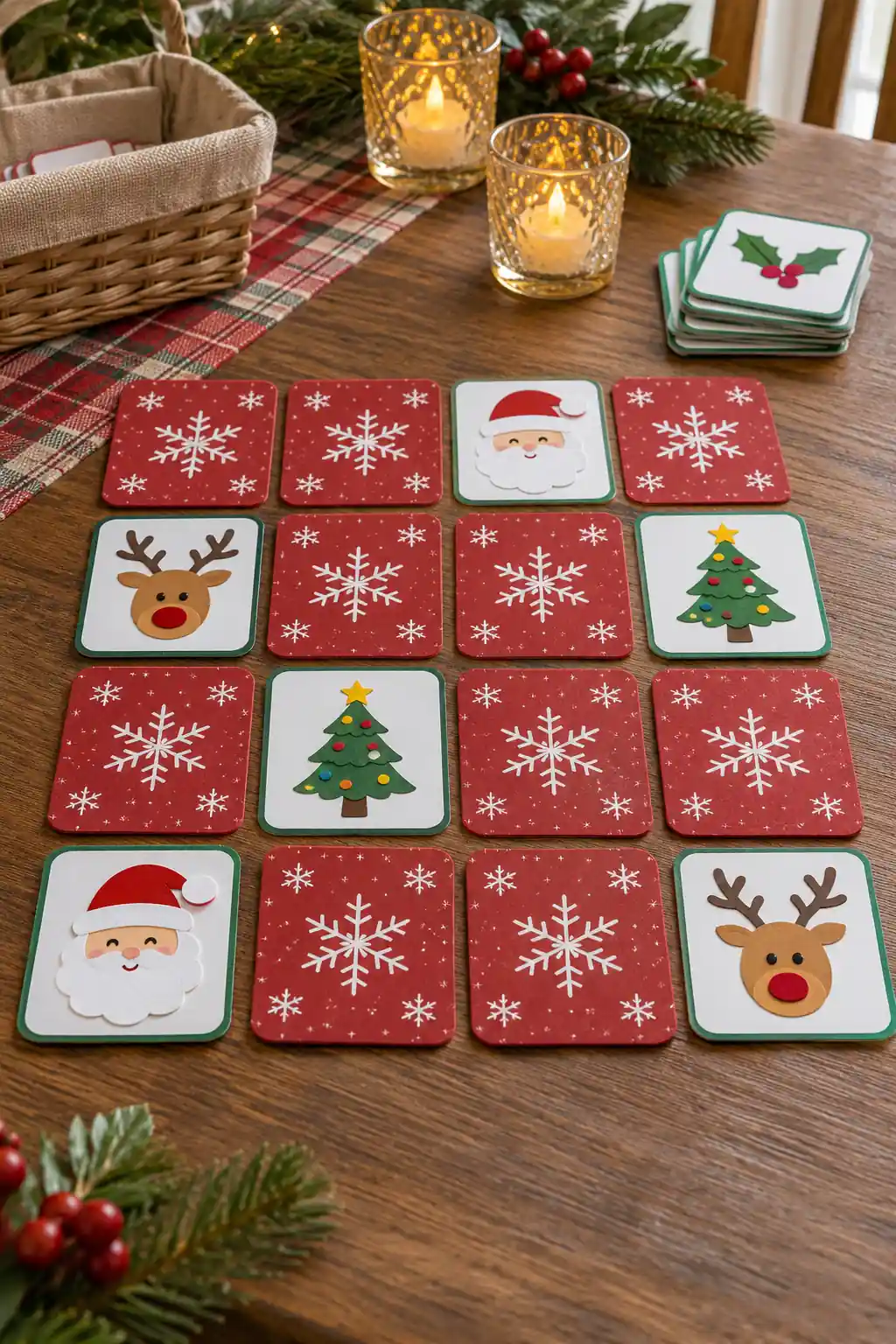
Matching picture cards create a quieter station between movement games. The red patterned backs conceal pictures of trees, reindeer, and Santa. Make each pair identical on the front and every card identical on the back. Thick paper prevents a dark illustration showing through during play.
Shuffle the deck, then arrange it face down in straight rows. Players turn over two cards per turn. Matching cards stay with the player; unmatched cards return to the same positions. Decide whether a successful match earns another turn before starting.
Begin with six pairs for a short round and add more only if the group wants a longer challenge. Large images help guests see across the table. Leave space between cards so they can be lifted without moving neighboring cards. A cooperative version asks everyone to find all pairs together, with no timer or individual score. Keep the finished deck in a labeled envelope.
7. Tabletop candy cane hook game
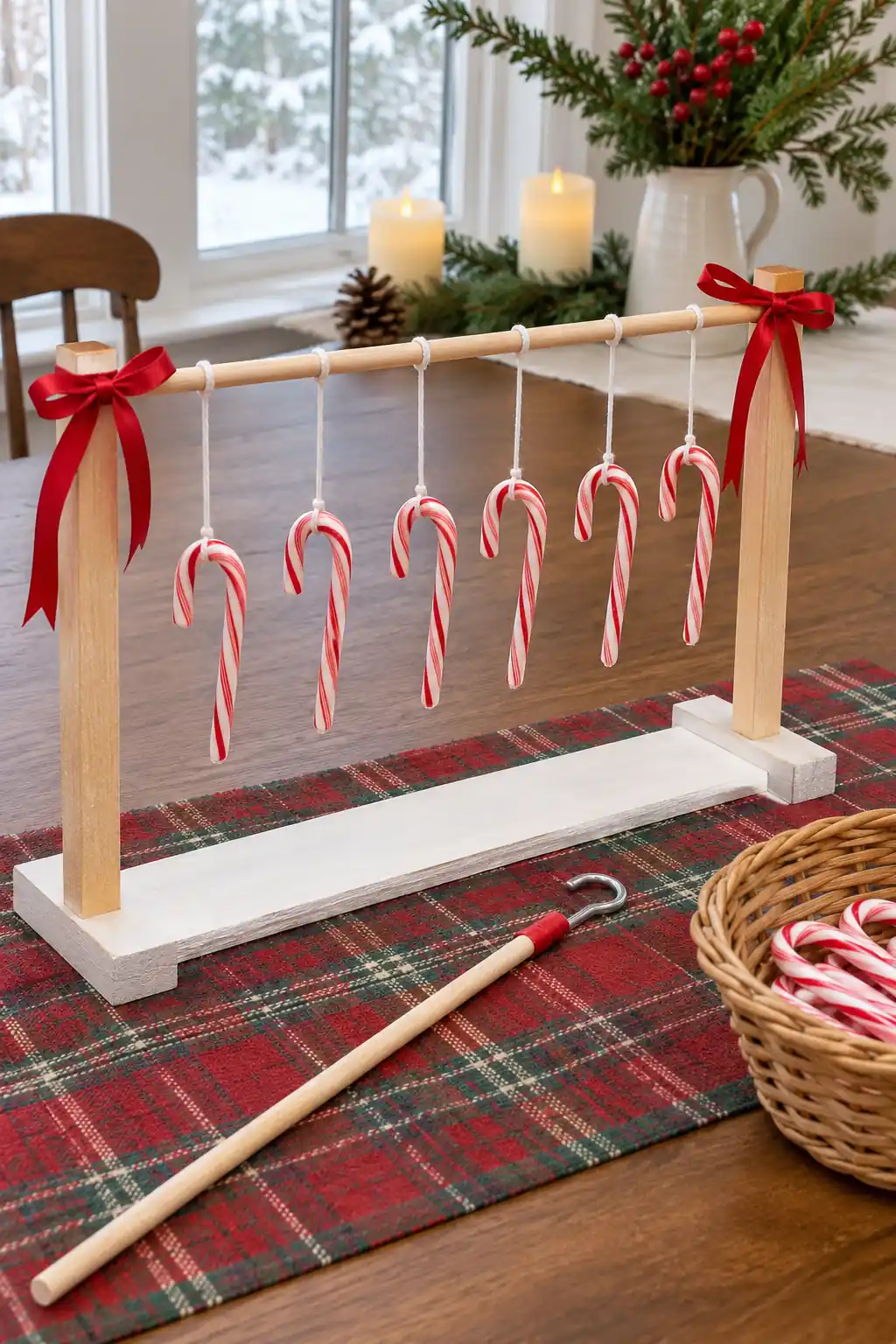
A small wooden rail gives this candy cane game a clear target area. The pictured canes hang from short strings, with a hooked stick nearby. Use lightweight reusable canes for repeated play rather than brittle sweets. Check each hook and the rail for sharp edges before setting up.
Ask players to lift one cane from its string using the handheld hook. Move it to an empty bowl without touching it with the other hand. Count successful transfers during one minute, or allow five attempts without a timer. Keep the hook in the player’s hand throughout the game.
Space the hanging loops far enough apart that one cane does not pull down its neighbors. A wide base helps prevent the rail tipping. For seated play, bring the rail close enough to avoid reaching across the table. If real wrapped sweets are prizes, keep them separate from the pieces everyone handles during the game.
8. Picture bingo with reusable boards
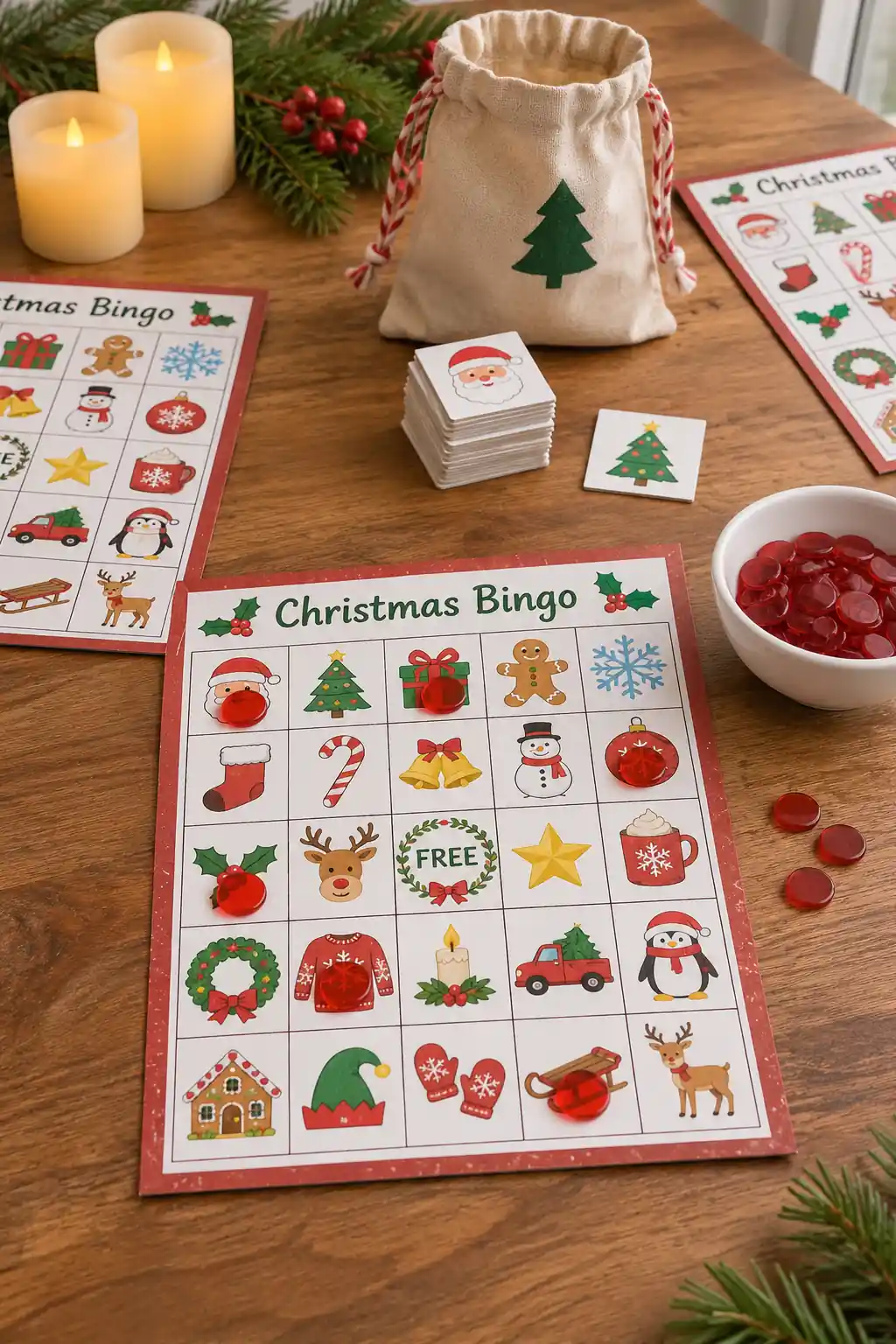
Picture bingo suits guests who prefer a seated game with clear turns. The reference combines familiar holiday images in a square grid. Print a different arrangement for every player while keeping the same pool of pictures. Matching boards would produce several winners at once.
Put one calling card for each picture into a bag. Draw a card, show it clearly, and name the image. Players cover the matching square on their own board. Start with a single completed row as the winning condition, then try corners or a full board later.
Use large paper markers when small counters are unsuitable for your guests. Check a winning board against the drawn cards before beginning another round. Keep a spare board available for late arrivals. These Christmas bingo ideas can help you vary the pictures without changing the familiar rules. Store calling cards separately so none disappear among the player boards.
You may also like: Christmas bingo ideas.
 You may also like19 Thanksgiving Cupcake Ideas for a Festive Dessert
9. Wrapped gift stacking contest
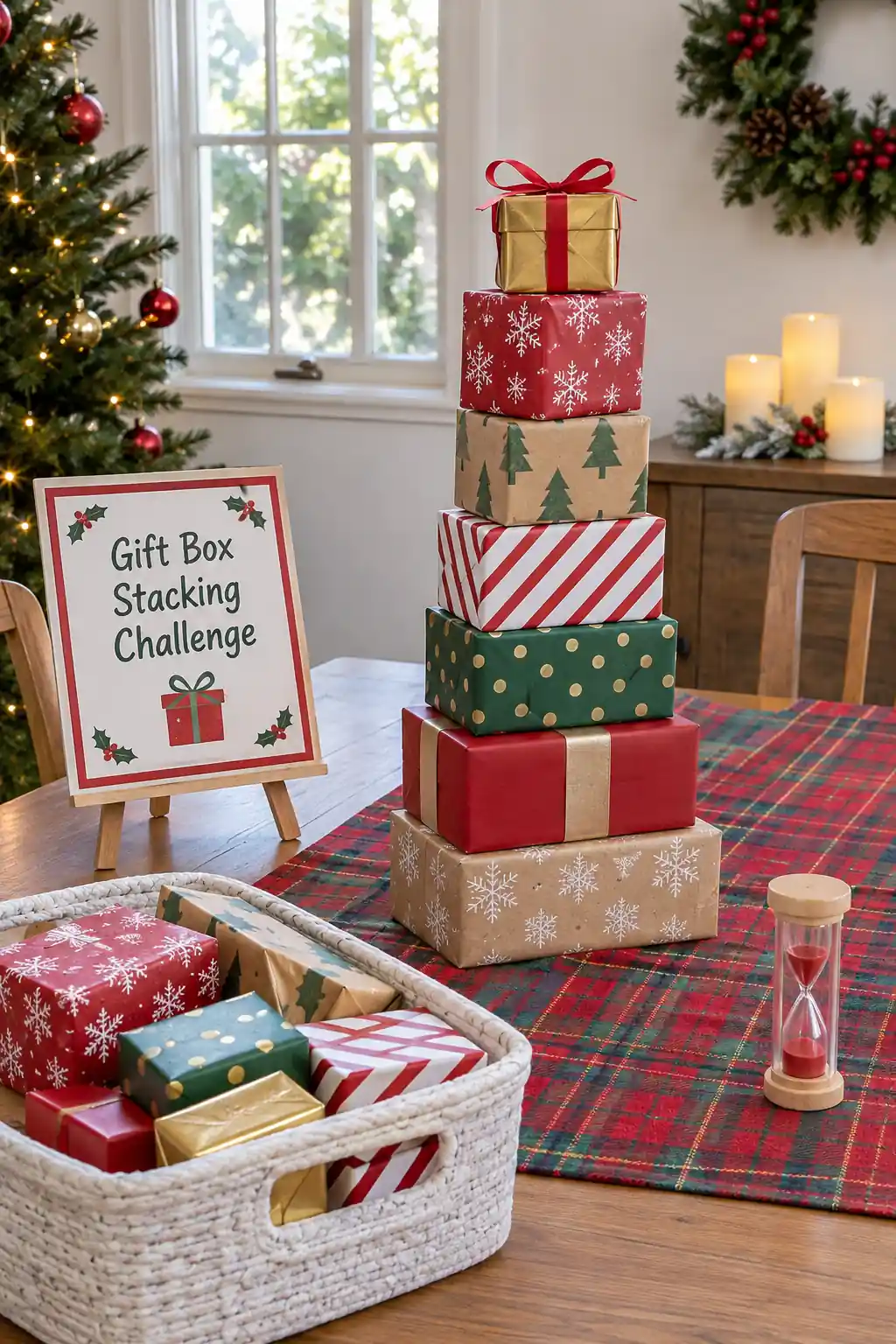
Wrapped empty boxes make a stacking challenge that also decorates the game table. The image uses different sizes, so players must decide which base supports the next box. Avoid heavy contents or glass ornaments inside the packages. Tape loose wrapping paper flat so it does not catch between boxes.
Give every player the same set of six or seven boxes. Allow one minute to build a tower that remains upright for five seconds. Measure the height only after hands leave the tower. Alternatively, award a point for every box in a stable stack instead of measuring.
Keep the tower below face height, and use a low table or clear floor mat. A team version lets one person choose boxes while another stacks. Save ribbons for the display afterward because bulky bows can make the challenge depend on decoration. Flatten boxes for storage where possible, noting which sizes belong in each complete set.
10. Place the nose on Rudolph
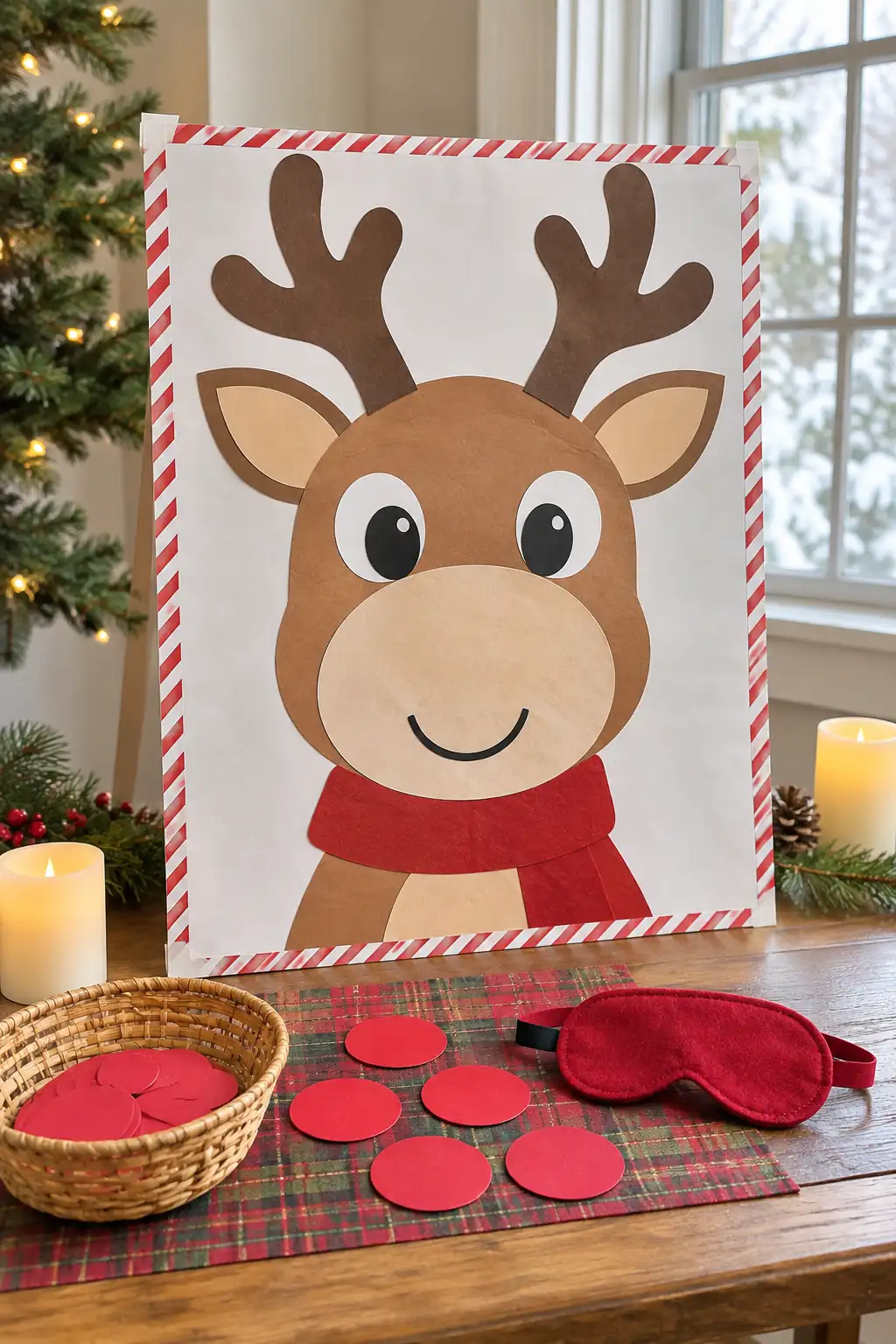
A large paper reindeer face creates a recognizable target for red paper noses. Use removable adhesive dots instead of pins. The poster can be taped to a wall at a comfortable reaching height. Check the adhesive on the surface first, and keep the surrounding floor clear.
Write a player’s name on each nose before taking turns. Guests may close their eyes or choose a loose blindfold if comfortable. Position them directly in front of the poster without spinning them. They place the nose once, then step away before the next person approaches.
Measure the closest nose to the intended position, or celebrate every placement without scoring. Offer an eyes-open version using the nondominant hand for anyone who dislikes blindfolds. A helper should stay beside the player without directing their reach. Keep the poster low for seated guests and children, rather than asking anyone to stretch above their natural reach.
11. Envelope scavenger hunt
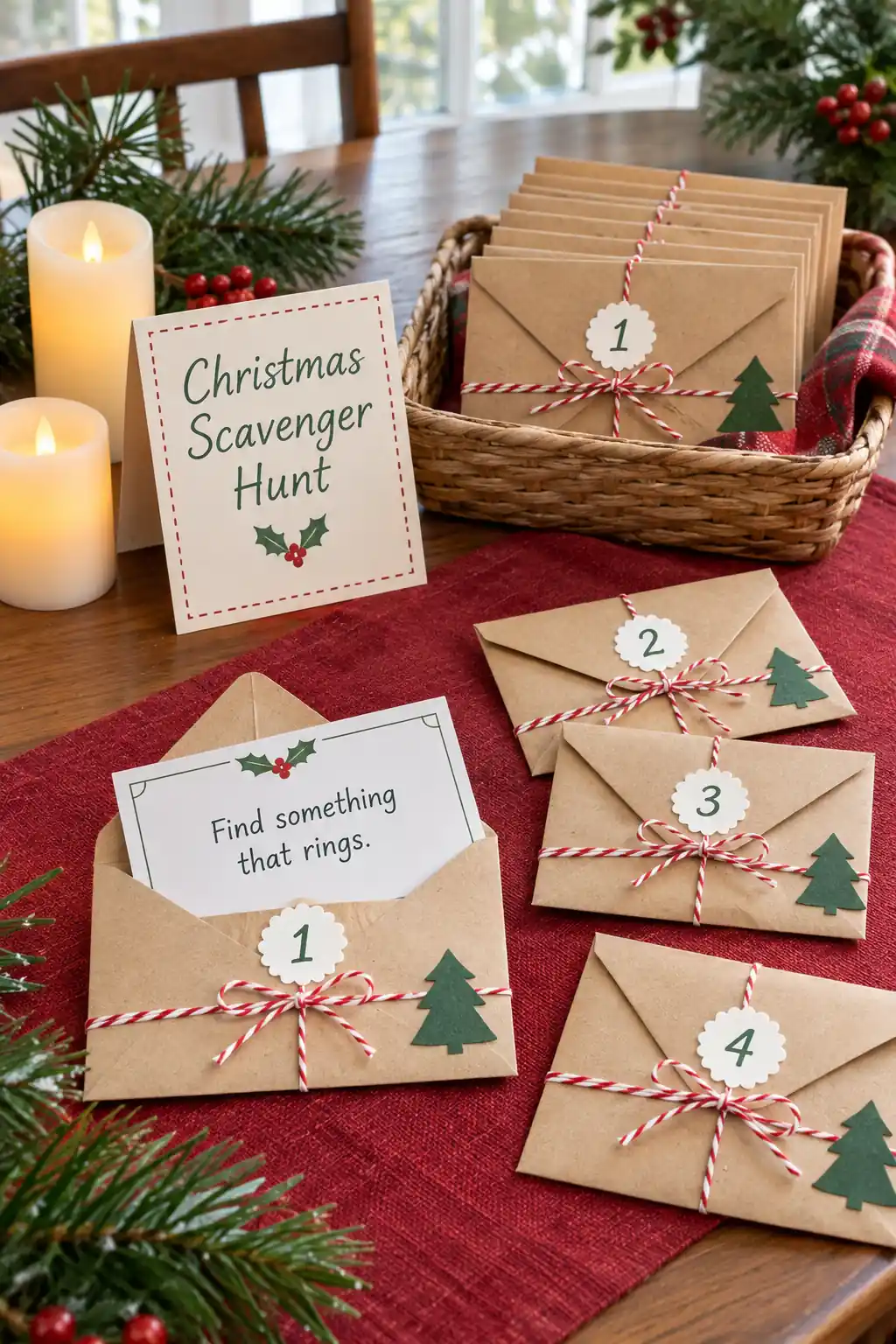
Numbered envelopes make a scavenger hunt easier to manage than loose notes. The reference uses matching kraft paper and red twine. Write each clue on a separate card so you can replace confusing wording without rebuilding the envelope. Keep an answer list for the host.
Choose four or five locations that guests can access without opening private cupboards. A clue could lead to a bookcase, coat rack, or wrapped empty box. Test the route in order before the party. Hide clues within ordinary reach, away from stairs, heaters, and fragile decorations.
For teams, use different envelope colors or stagger starting points to avoid crowding. Younger children can follow picture clues with an adult. Finish with a shared activity or basket of labeled prizes rather than one winner taking everything. Collect all envelopes afterward, checking your location list so paper scraps do not remain hidden around the house.
12. Jingle bell box shake
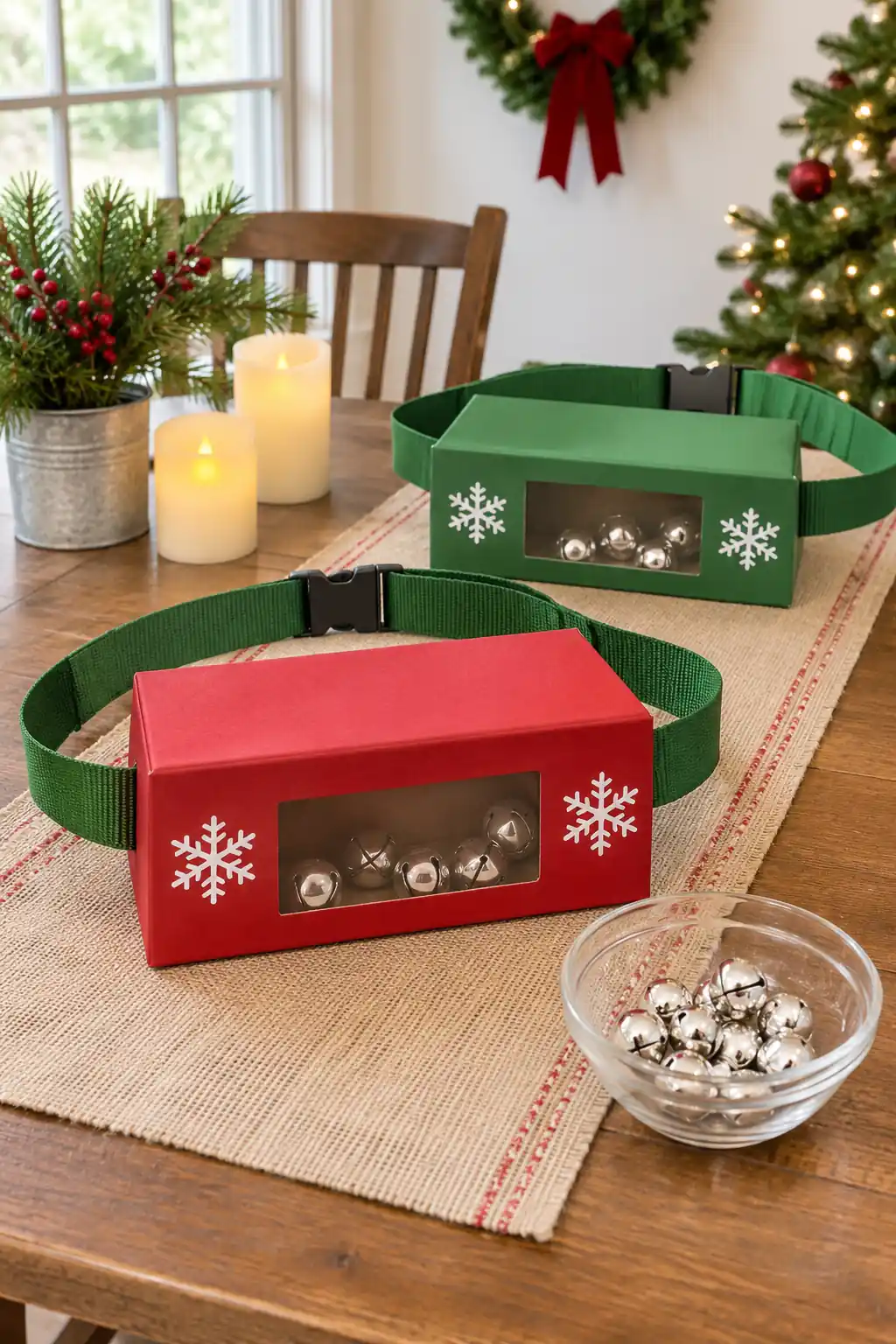
Waist boxes turn movement into the challenge, with loose bells leaving through an opening. This version suits adults and older children who can manage the equipment. Bells are small parts, so keep them away from younger children and pets. Count every bell before and after play.
Use a lightweight box with smooth cut edges and a belt that releases easily. Fit it comfortably around the waist without tight knots. Give each player the same number of bells, then time a short round. The goal is to empty the box using movement while keeping hands away.
Clear a separate area for each participant so nobody collides. Offer a tabletop alternative where players tilt a box with their hands. Collect fallen bells immediately between rounds before anyone walks through the area. If the noise bothers guests, replace this station with the gift stacking challenge. Keep the game brief, and let players stop whenever they choose.
You may also like: Christmas contest ideas.
13. Christmas trivia at the table
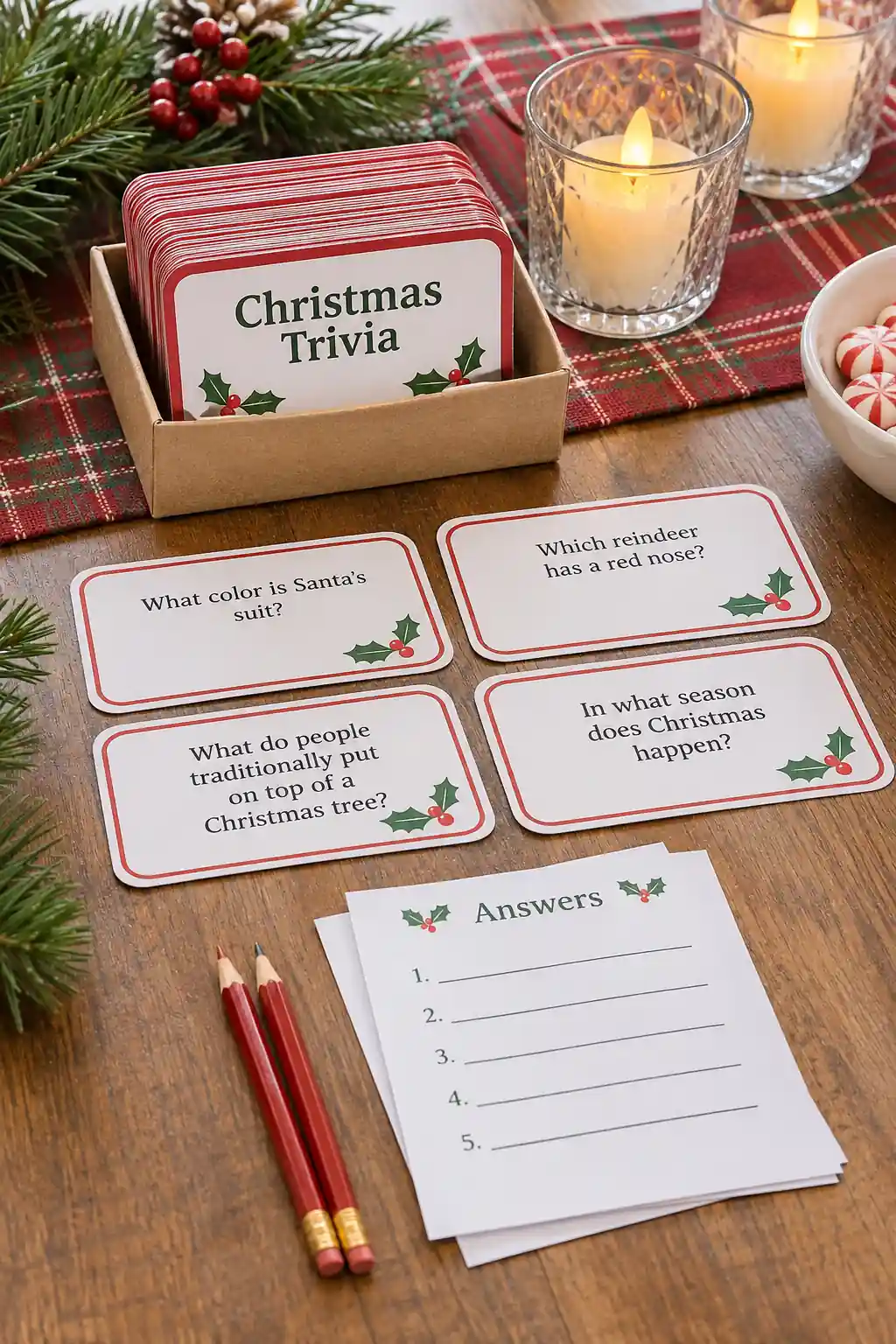
Printed trivia cards give seated guests a game they can join without moving furniture. The pictured cards use short questions and separate answer sheets. Write your own verified questions rather than copying text visible in an AI image. Keep a dated answer key if facts depend on a particular film or edition.
Mix straightforward questions with a few harder ones. Read each question aloud and also show it in large print. Give teams time to discuss before writing one answer. Avoid relying entirely on one country’s traditions unless every guest shares that background.
A ten-question round usually feels more manageable than an open-ended quiz. Announce the scoring before reading the first question, including whether partial answers count. Include a noncompetitive option where the table works together. Put pencils at both ends of a long table so nobody needs to reach across drinks. Review disputed answers calmly against the source you used during preparation.
14. Roll and build a snowman
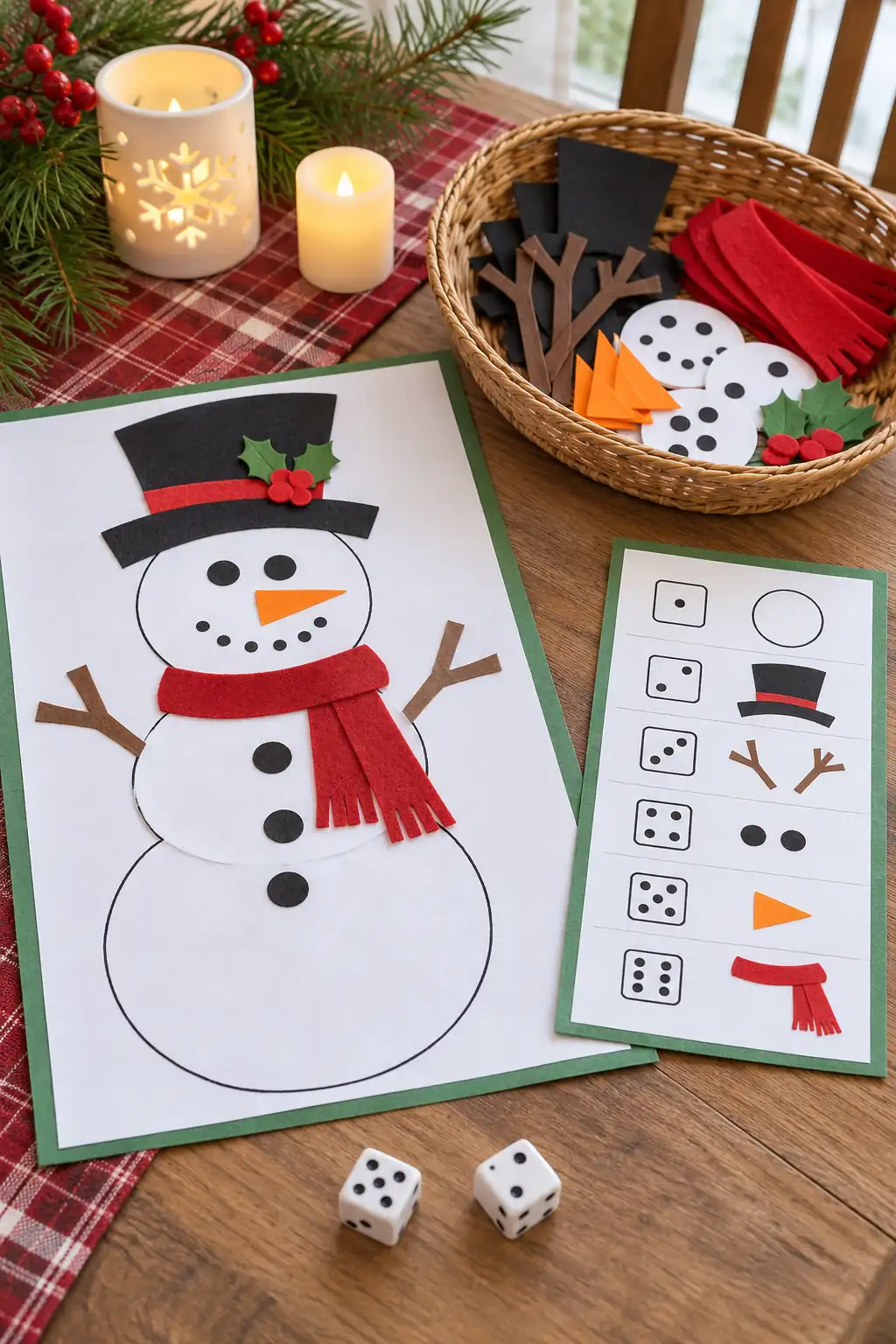
A snowman template and dice guide combine chance with drawing or paper assembly. The reference uses separate paper accessories, which guests can place on a large outline. Assign one feature to each number on a standard die. For example, one adds the body and six adds a scarf.
Players take turns rolling and adding the matching feature. Decide what happens when a number repeats. They might pass, add another snowflake, or roll again after completing every required feature. Keep that choice consistent throughout the round so nobody argues about an unfinished snowman.
Use large paper pieces instead of tiny buttons for a group with young children. Adults can prepare the cutouts in advance. A drawing version needs only paper and thick pencils, which makes cleanup quicker. Finish when everyone completes a snowman rather than stopping at the first winner. Let guests take their pictures home after the paper pieces are attached.
15. Christmas tree beanbag target
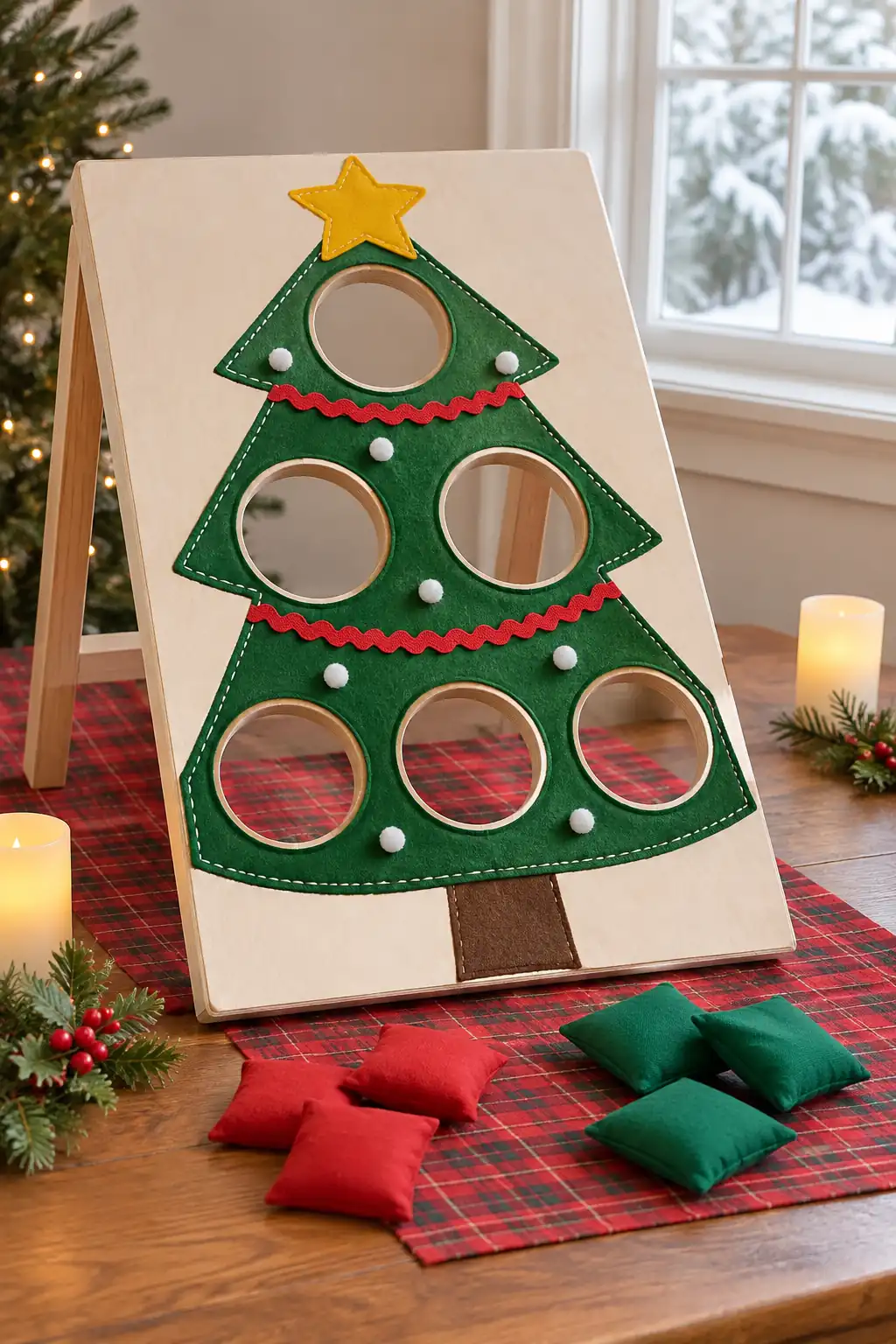
Round openings in a tree-shaped design give beanbags several clear targets. The image shows a sloping wooden board with red and green bags. A purchased game board can be decorated with removable paper shapes, avoiding an unnecessary woodworking project. Check that its support remains secure during play.
Choose a throwing line after testing the board with the actual beanbags. Award one point for the lowest openings and more for smaller or higher targets. Give everyone the same number of throws. Explain whether bags resting on the board count before the first round.
Leave space behind the target so missed bags do not hit furniture or people. Use soft, intact beanbags with secure seams. A seated player can use a closer line if that makes the activity more accessible. For cooperative play, set a group score and record progress after each turn. Store the board flat only if its support folds as intended.
16. Guess the Christmas scent
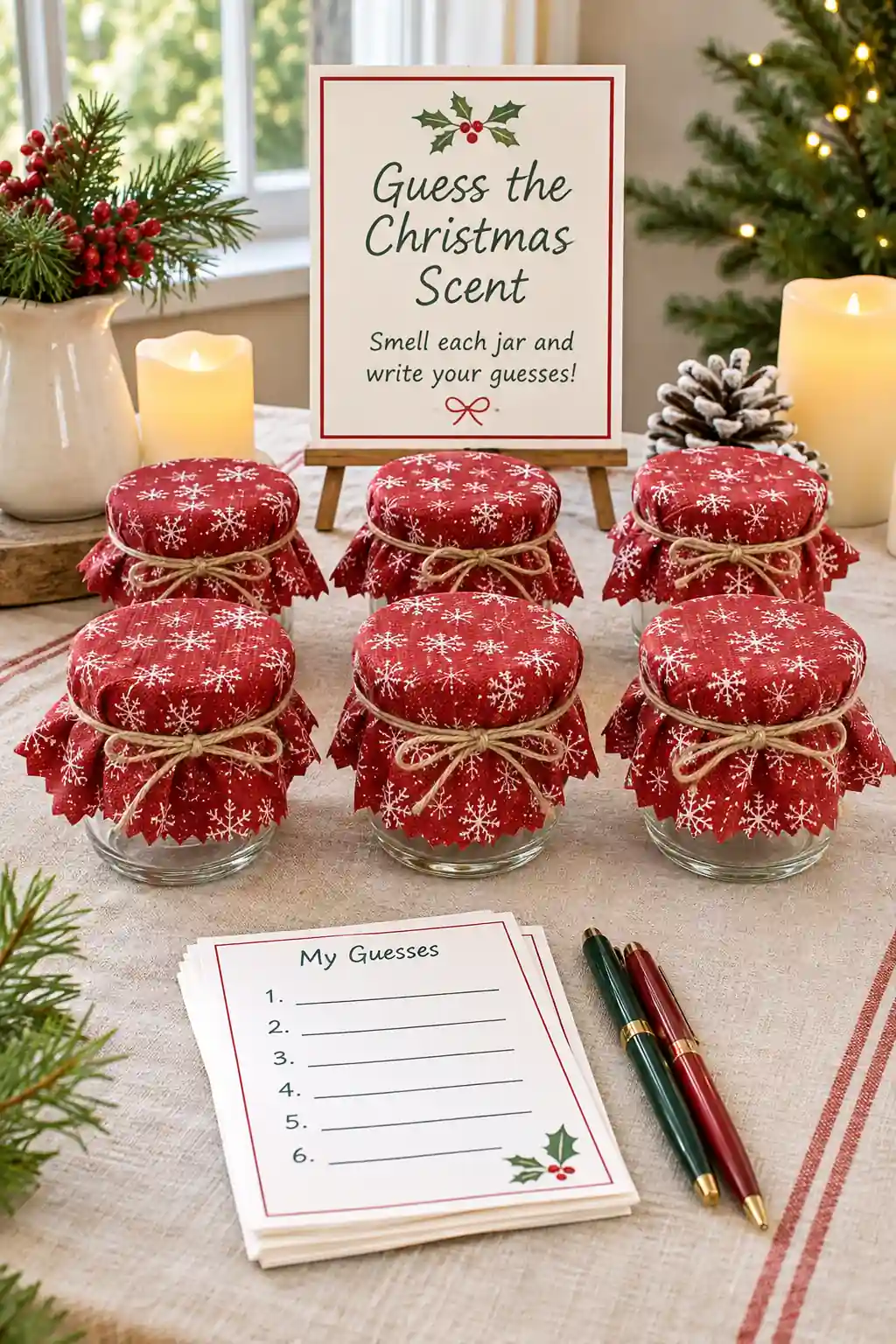
Covered jars hide their contents while leaving room for a scent guessing activity. Cinnamon sticks and orange peel are possible choices, but check guests’ sensitivities first. Avoid concentrated essential oils or unknown fragrance mixtures. Anyone who dislikes scent activities should have an equally welcome alternative.
Number the jars and keep the answer list out of view. An adult can present one open jar at a time without touching it to anyone’s face. Guests write a guess or describe the scent without naming it. There is no need for blindfolds because the cover already hides the contents.
Use separate clean containers for each ingredient, and do not offer handled game contents as food afterward. Skip any ingredient linked to a guest’s allergy. Keep glass jars on a stable table, away from active games. A picture matching version can replace smelling altogether while preserving the guessing format for the same group.
Choose Christmas party game ideas for your room
For one table, combine memory cards, trivia, and picture bingo. A clear floor area makes room for soft toss games. Keep active play away from food, decorations, and doorways.
Write one short rules card per station. Include the number of turns, scoring, and a seated alternative. Store spare equipment beneath the host’s table rather than scattering it around the room.
Plan a short game rotation
Start with one shared activity so guests understand the pace. Then offer a choice between an active station and a quiet table. Stop before people become tired, even if every planned round is unfinished.
Use small shared prizes or a group photo instead of expensive rewards. A clear finish makes it easier to return the room to eating and conversation.

Written by Stephanie Fallis
Mom and homemaker who shares budget friendly DIY projects, decorating tips and gardening ideas for busy families.
More about me → Christmas ideas16 Christmas party centerpiece ideas for your table
 Christmas ideas17 Christmas Backdrop Ideas for Festive Photos
 Party Ideas20 Christmas Photo Booth Ideas with Room for Guests and Photos